Route 66’s Mountain Detour: The Road Through Glorieta Pass to Santa Fe
When people imagine Route 66, they usually picture long, straight highways stretching across open desert. But for its first decade, the Mother Road took a surprising detour—climbing into the mountains of northern New Mexico on its way to Santa Fe.
Between 1926 and 1937, travelers approaching from the east didn’t head directly to Albuquerque. Instead, they turned north near Santa Rosa and followed a winding road toward the Sangre de Cristo Mountains, eventually crossing Glorieta Pass before descending into Santa Fe. It was one of the most scenic—and historically layered—segments of early Route 66.
As the road climbs into the pass, the landscape shifts from open plains to forested foothills scented with piñon and juniper. The railroad tracks of the Atchison, Topeka & Santa Fe Railway thread through the same valley, occasionally appearing beside the highway before slipping behind low ridges. For generations, travelers of every kind have followed this natural corridor into Santa Fe.
Long before automobiles arrived, this route formed part of the Santa Fe Trail, the famous 19th-century trade route connecting Missouri to the markets of New Mexico. Near the top of the pass sits Pigeon’s Ranch, once a stage stop along the trail. In 1862, the surrounding hills became the site of the Battle of Glorieta Pass, where Union troops destroyed a Confederate supply train and halted the southern army’s advance into the Southwest.
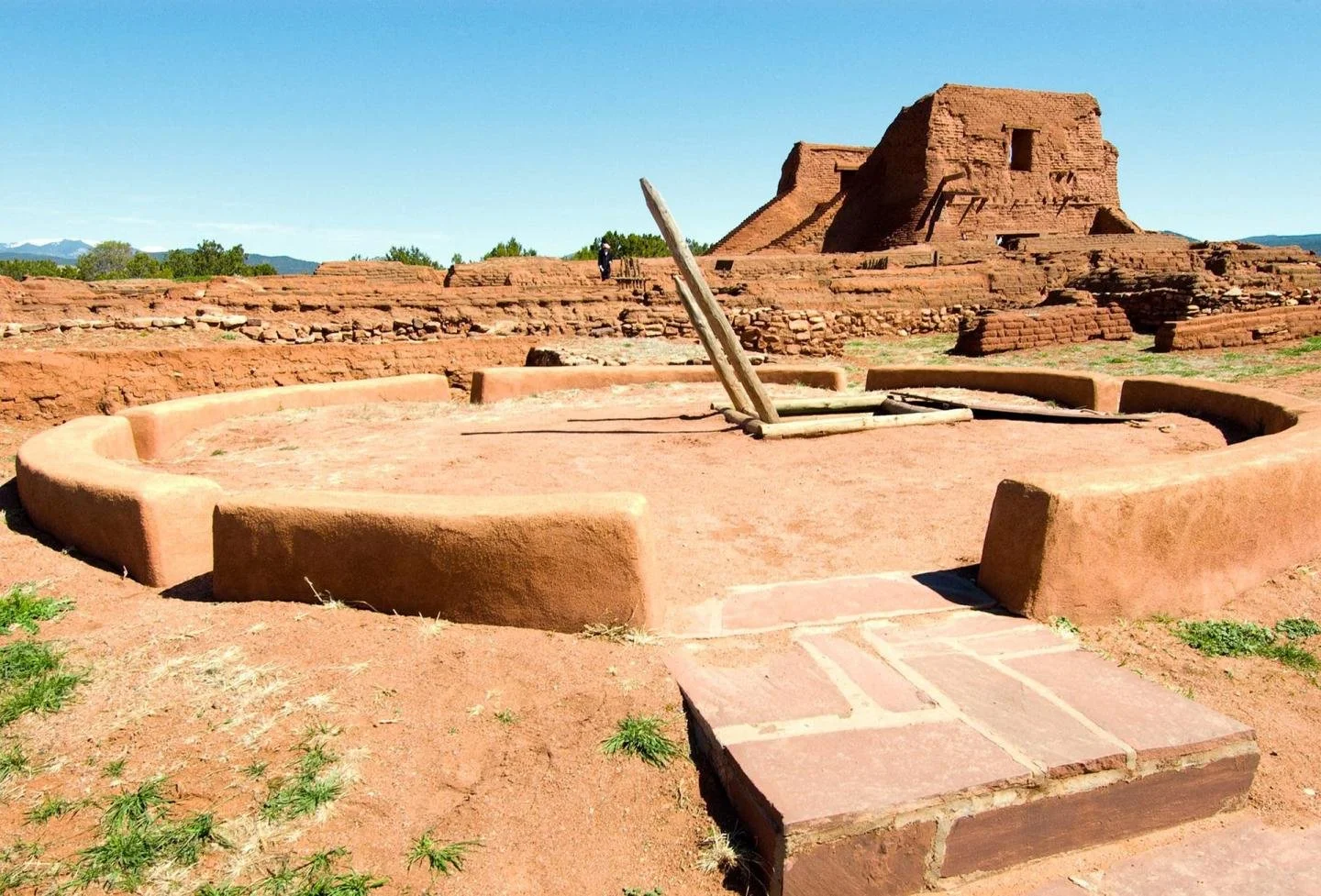
Just east of the pass lies one of northern New Mexico’s most remarkable historic landscapes: Pecos National Historical Park. Here the ruins of Pecos Pueblo rise above the valley, marking a once-powerful Indigenous trade center that thrived for centuries. Nearby stand the towering adobe remains of a Spanish mission church, while wagon ruts from the Santa Fe Trail still trace faint lines across the surrounding hills.
Early Route 66 motorists passed directly through this layered landscape, continuing through Pecos and toward the small mountain community of Cañoncito. From there, the road crests the foothills and begins a sweeping descent—one of those quiet, memorable moments where the Santa Fe basin suddenly opens before you.
By 1937, Route 66 was rerouted through Albuquerque, leaving this mountain loop behind. But the scenery—and the stories—remain.
To celebrate the 100th anniversary of Route 66, travelers can once again experience this historic drive with guided trips offered by Great Southwest Adventures, retracing the original route over Glorieta Pass and into Santa Fe much as early road-trippers did nearly a century ago.