A Broken Wagon Wheel and the Birth of the Taos Art Colony
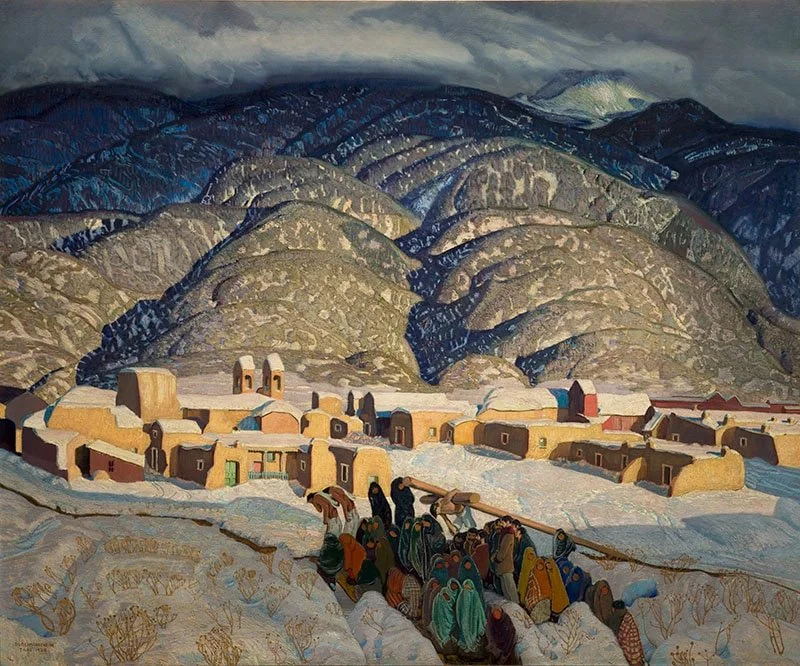
Long before Taos became a destination for skiers, photographers, and weekend travelers, it became something far rarer: a place artists felt compelled to stay.
At the turn of the twentieth century, northern New Mexico still felt remote from the American mainstream. The railroad had arrived nearby, but Taos remained a small, isolated community at the foot of the Sangre de Cristo Mountains — a place of adobe walls, wood smoke, church bells, and vast luminous skies. For a generation of artists coming from crowded eastern cities, it seemed less like a town than a revelation.
The story of the early Taos Art Colony often begins with Ernest Blumenschein and Bert Geer Phillips. In 1898, while traveling through New Mexico, the two painters reportedly broke a wagon wheel near Taos. What might have been an inconvenience became a turning point in American art history. They encountered a place unlike anything they had seen: dramatic light, striking landscapes, and cultures that seemed deeply rooted in the land itself.
More artists followed. In 1915, several formed the Taos Society of Artists, helping establish Taos as one of America’s first major art colonies. Their paintings carried images of New Mexico back to galleries and collectors in Chicago, New York, and Boston. Suddenly, Taos was no longer isolated. It had become mythic.
Of course, the colony reflected the contradictions of its era. Many artists romanticized Pueblo and Hispanic life through an outsider’s lens. Yet they also preserved invaluable visual records of northern New Mexico at a moment of enormous change. Their work captured not just scenery, but atmosphere: the sharp mountain light, the silence of adobe plazas, the sense of time moving differently here.
That may be the enduring power of Taos. Artists came searching for subjects. What they found instead was a place that changed the way they saw the world.