Georgia O’Keeffe - The Insider Who Rewrote the Rules
If you arrive in northern New Mexico the usual way—through Santa Fe—you’re quickly taught how to look. Adobe walls, carved doors, saints and stories, layers of culture that ask to be read. Early painters of the region did just that: they looked for people, for narrative, for the visible texture of life.
Then O’Keeffe shows up—and quietly declines the assignment.
By the time she begins spending long stretches in New Mexico in the late 1920s, the visual language of the Southwest is already well established. Painters associated with the Taos Society of Artists have built a reputation on scenes of daily life—figures in doorways, ceremonies, labor, presence. The landscape is important, yes, but it’s a setting. The story belongs to the people within it.
O’Keeffe walks into that world and does something that, at first, barely registers as radical: she removes the people.
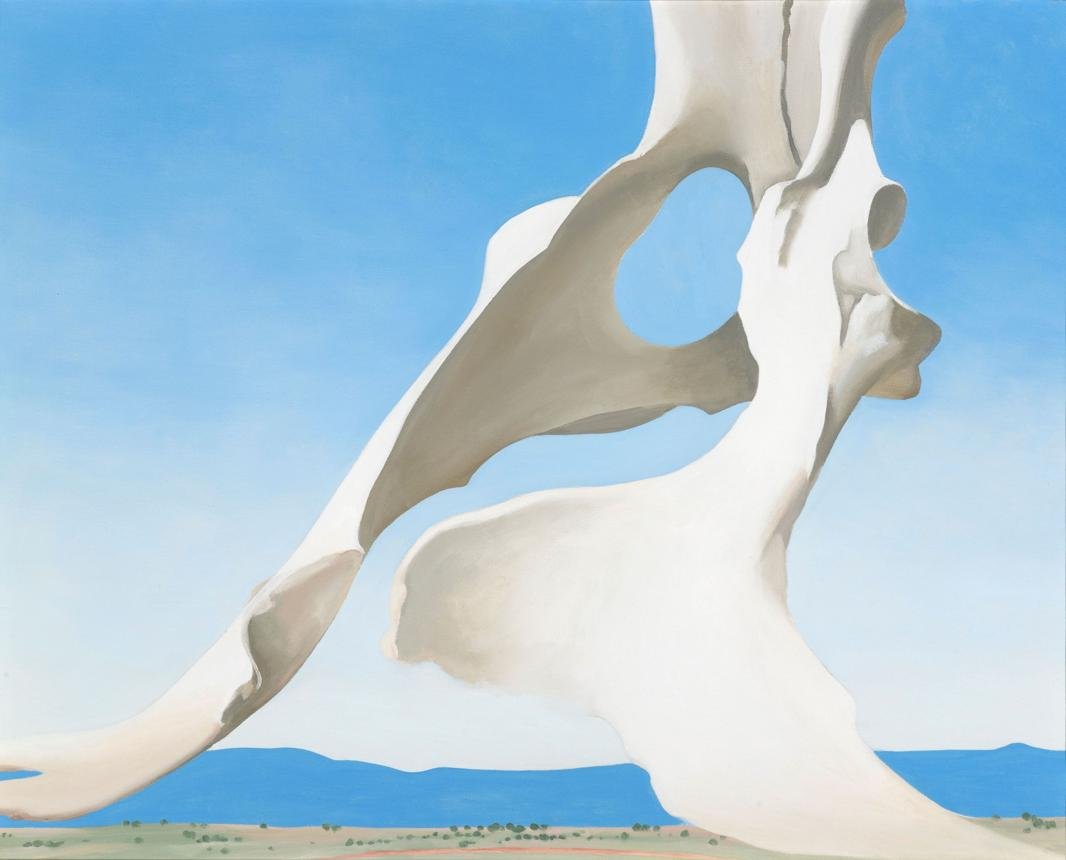
No crowds. No ceremonies. No anecdote. No visible history. What remains are hills, bones, sky, a single mountain repeated until it becomes unmistakable. Stand out at Ghost Ranch and you begin to understand the move. There is so much space here that the usual human story feels… optional.
Or maybe unnecessary.
This is where she becomes an insider in the deepest sense. Not because she adopts the existing artistic language—but because she allows the place itself to set the terms. Others arrived and asked, Who lives here? O’Keeffe seems to ask, What is here if no one is speaking?
It’s a different kind of attention. Look at one of her views of Cerro Pedernal. The mountain isn’t described so much as declared. Edges sharpen. The sky flattens. The composition reduces until the whole scene feels inevitable, as if it could not possibly be otherwise. This isn’t landscape as observation—it’s landscape as decision.
And that decision extends beyond the canvas. Her home in Abiquiú—Georgia O’Keeffe Home and Studio—does the same work in adobe and shadow. A black door, a rectangle of sky, a wall stripped of ornament. She didn’t just paint this way; she arranged her life to match it.
Which is where the “rule-breaking” becomes clear.
The unwritten rule in early Santa Fe painting was that the artist serves the subject—interprets it, preserves it, gives it form. O’Keeffe reverses that. She lets the subject reduce itself, and then follows it all the way down. What matters is not the story you can tell about a place, but what remains when the story falls away.
There’s a geological echo to this, and you can feel it driving north out of Santa Fe. The land opens along the Rio Grande Rift, stretches, thins, and then begins to show its layers as you approach the edge of the Colorado Plateau. Time, built up and carved back. What you’re seeing out there is what couldn’t be removed.
O’Keeffe paints the same way.
That’s why her work can feel both simple and immense. It isn’t trying to capture everything—only what endures. A curve of hill. A line of horizon. The outline of Pedernal against an empty sky.
In a region where so many artists worked to understand a place through its people, O’Keeffe found another path: understand the place so deeply that people become unnecessary.
Not absent—just no longer required.
And in doing so, she didn’t step outside the tradition of the Southwest. She went further in—past story, past description, to something quieter and harder to name.
A way of seeing that, once learned, is difficult to unlearn.
You look again at the land—and realize how much you’ve been adding to it.