The Other Bandelier Worth Seeing
Visitors to Bandelier National Monument often arrive with a single destination in mind: the cliff dwellings tucked into the soft volcanic tuff of Frijoles Canyon. And rightly so—the ladders, cavates, and sweeping canyon views are unforgettable. But just beyond that well-trodden path lies a quieter marvel, one that rewards a slower, more attentive eye.
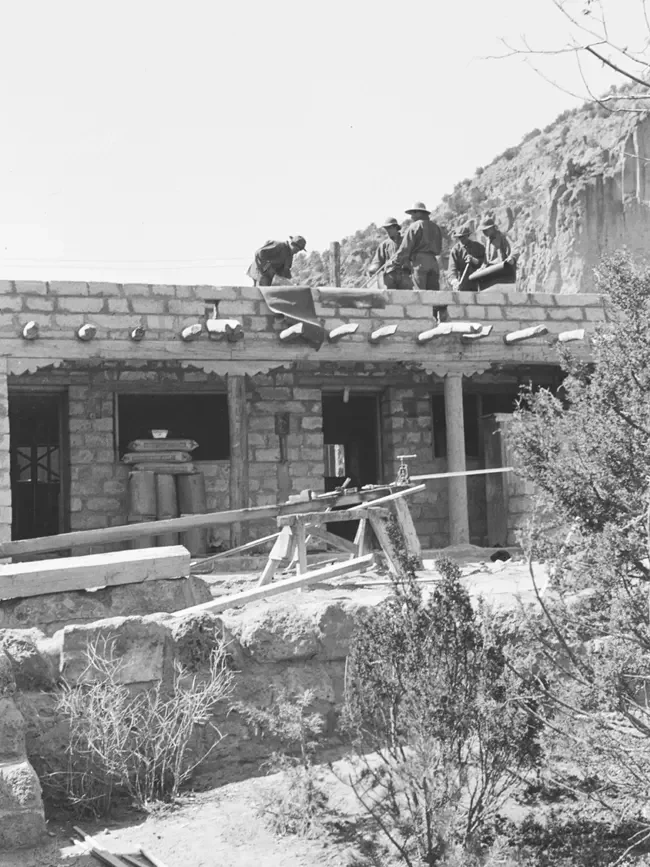
In the heart of the canyon sits the Bandelier Civilian Conservation Corps Historic District, a place where architecture, landscape, and history settle into an almost effortless harmony. Between 1935 and 1941, young men of the Civilian Conservation Corps transformed this remote canyon into a functioning national park headquarters. What they left behind is not just infrastructure, but a masterclass in thoughtful design.
There are 29 Pueblo Revival-style buildings here, constructed from hand-cut blocks of local tuff—the same stone that forms the canyon walls. The choice of material wasn’t just practical; it anchors the structures visually and spiritually to the land itself. Step inside, and the craftsmanship continues: hand-hewn vigas, custom furniture, and iron light fixtures reflect a level of care that feels almost personal.
What makes the district especially compelling is its cohesion. The buildings are not scattered randomly but arranged with intention, wrapping around a central plaza and rising in gentle tiers from Frijoles Creek. The layout feels organic, as though it emerged from the canyon rather than being imposed upon it. Even today, the district remains the largest unaltered collection of CCC-built structures in the entire National Park system.
It’s easy to walk past this ensemble without fully seeing it. After all, it doesn’t demand attention the way the cliff dwellings do. But linger for a moment—notice the way stone meets sky, the quiet geometry of the plaza, the way everything seems to belong.
In a park celebrated for its ancient past, this “modern” layer—now nearly a century old—offers its own kind of wonder. Not just what was built, but how thoughtfully it was done.