Kate Chapman: The Woman Who Built the New Old Santa Fe
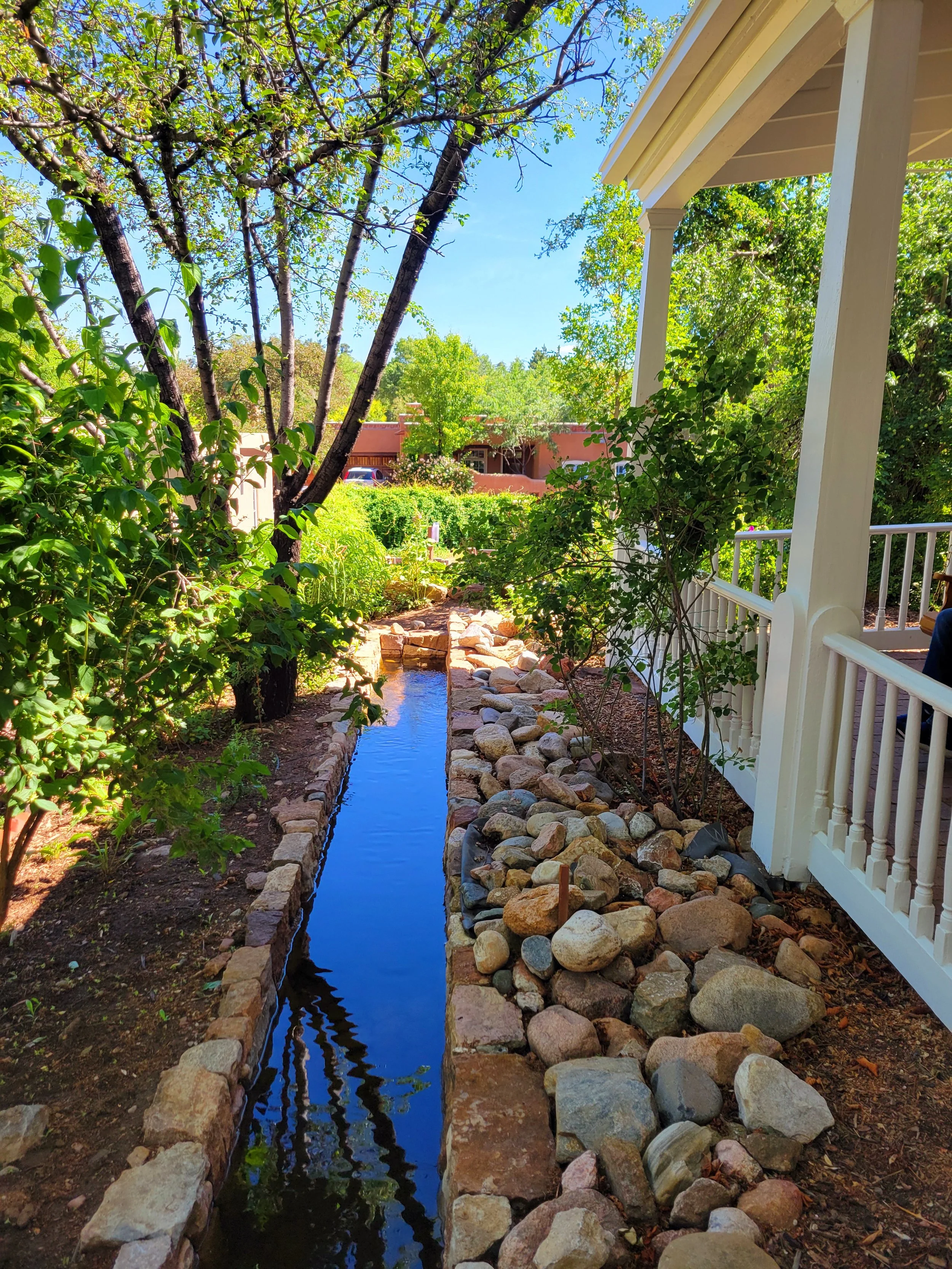
The acequia in the garden of El Zaguán, where Kate Chapman transformed an old adobe compound into a place that could continue to live and evolve.
If you have ever wandered down Canyon Road, you have probably noticed El Zaguán. Its thick adobe walls, wooden vigas, covered portal, and intimate courtyard seem to embody everything we mean when we talk about “old Santa Fe.”
But El Zaguán is not simply an old house that happened to survive. Much of what we see today reflects the work of a remarkable woman named Kate Chapman—a designer, builder, and preservationist who helped shape the Santa Fe we know today.
Chapman is not nearly as famous as Edgar Lee Hewett or John Gaw Meem, whose names are closely associated with the development of Santa Fe Style architecture. Yet her approach to old buildings was in some ways more radical. Rather than simply designing new buildings that looked old, Chapman worked with existing adobe structures, adapting them to modern life while preserving their character.
That distinction matters.
Building a new Santa Fe by saving the old one
Kate Muller Chapman came to New Mexico in 1910, when Santa Fe was just beginning its transformation into the romanticized “Old Santa Fe” that visitors recognize today. By the 1920s and 1930s, she was designing adobe houses and directing local craftsmen in their construction. She became particularly skilled at rehabilitating nineteenth-century adobe houses—enlarging them, rearranging their interiors, and making them comfortable for modern occupants without erasing their history.
In 1928, Margretta Dietrich purchased the old Johnson House on Canyon Road, a property dating to the nineteenth century. Chapman transformed the compound, which became known as El Zaguán, into apartments and made additions that respected its traditional character. The name itself refers to the long covered passage leading from the street into the courtyard, an architectural feature with deep roots in Spanish and Mexican New Mexico.
Today El Zaguán is home to the Historic Santa Fe Foundation. In a sense, it is also a monument to Chapman's philosophy: preservation does not have to mean freezing a building in time.
Adobe is not just a style
Chapman understood something that is easy to forget when we admire Santa Fe architecture today. Adobe is not merely an architectural style or a pleasing color palette. It is a building material with its own requirements.
Adobe walls need to be protected from water. They need maintenance. They need to breathe. They need appropriately designed roofs, parapets, portals, and drainage. Keeping an adobe building alive requires knowledge and continual care.
Chapman understood this from the ground up—quite literally.
In 1930 she collaborated with her friend, artist Dorothy N. Stewart, on a wonderfully eccentric little book called Adobe Notes: Or How to Keep the Weather Out with Just Plain Mud. Originally printed by Spud Johnson's Laughing Horse Press, it combined practical advice about adobe construction with Stewart's linoleum-cut illustrations and Chapman's folksy humor.
The title tells us something about Chapman herself. There is no solemn architectural rhetoric here. Adobe is simply “plain mud,” and keeping the weather out is the problem to be solved.
A city preserved one building at a time
Chapman worked on a number of Santa Fe houses. In addition to El Zaguán, her projects included Plaza Balentine and several historic adobe residences. Another particularly notable Canyon Road rehabilitation was the Borrego House, now home to Geronimo restaurant. Chapman received the McCormick Prize for that restoration.
Her work reveals another side of the creation of “Old Santa Fe.”
We often tell the story as though Santa Fe Style emerged from the drawing boards of a few prominent architects. But much of the city's transformation happened at a much smaller scale: an old adobe house here, a courtyard there, a portal added, a wall repaired, a room enlarged.
People like Kate Chapman made it possible for old buildings to remain part of a living city.
And that may be her most important legacy.
Santa Fe's historic character was not created simply by preserving the past. It was created by finding ways to live in the past without destroying it.
Walk through El Zaguán today and you can still see the result. The building feels old because much of it is old—but it also feels intentional, comfortable, and alive.
That is the genius of Kate Chapman.
She did not merely make new buildings look old.
She helped make the old buildings live again.
Kate Chapman's work is explored in Catherine Colby's Kate Chapman: Adobe Builder in 1930s Santa Fe, published by Sunstone Press. The book is available from the Historic Santa Fe Foundation at El Zaguán.