Zozobra: How Santa Fe Invented a Tradition
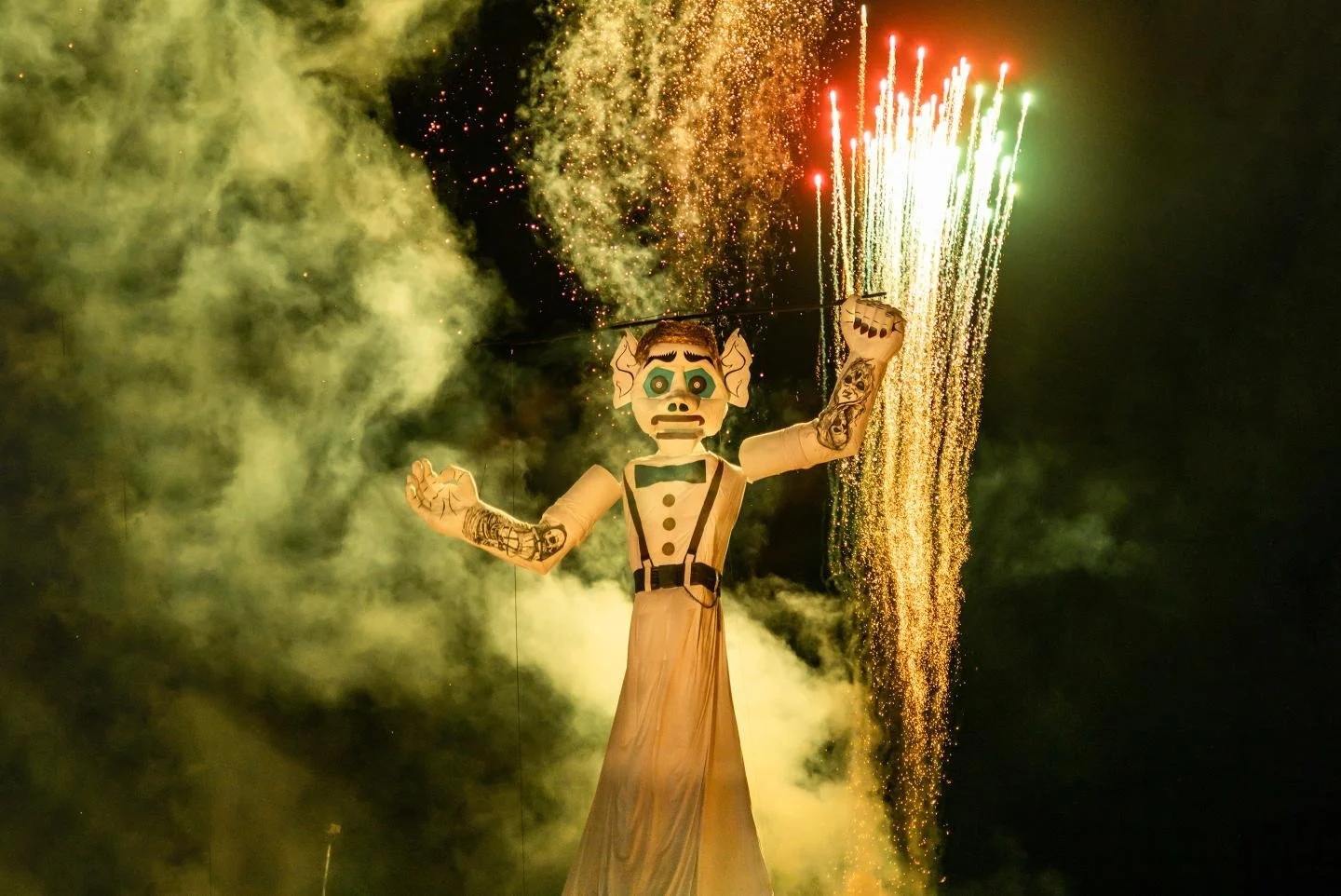
Every September, Santa Fe gathers to burn a 50-foot-tall monster.
It is one of those spectacles that seems so thoroughly “Santa Fe” that it is easy to imagine it has been here forever. But Zozobra is actually a remarkably recent invention—and its story tells us something important about the Santa Fe of the 1920s.
Zozobra was born not in some ancient Pueblo ceremony or Spanish colonial ritual, but among a group of young artists who were helping create a very different Santa Fe.
It began at La Fonda
The story begins on Christmas Eve, 1923, at the newly opened La Fonda on the Plaza.
Artist Will “Shus” Shuster had just sold a painting and, flush with the proceeds, treated his fellow artists to dinner. Shuster was one of Los Cinco Pintores—the “Five Painters”—a group of young modernist artists that included Jozef Bakos, Fremont Ellis, Walter Mruk and Willard Nash.
They were talented, adventurous, and, as Shuster's diaries make clear, generally short of money. Despite the celebratory dinner, his friends were in a gloomy mood.
Shuster decided to do something about it.
He gave everyone a piece of paper and told them to write down what was bothering them. Then he gathered the papers, lit them with a candle, and announced that their troubles were gone.
The group was apparently ejected from La Fonda.
It was a wonderfully Santa Fe beginning.
The little ritual gave Shuster an idea: perhaps gloom could be given a physical form—and then destroyed.
From artists' prank to Old Man Gloom
The other ingredient came from Mexico.
In 1924 Shuster encountered a Holy Week tradition involving an effigy of Judas that was paraded and ultimately burned. He combined that idea with his La Fonda experiment and created his own effigy.
The first Zozobra was only about six feet tall. It was burned at a private gathering of artists and friends.
Gustave Baumann, another prominent Santa Fe artist, helped with the creation and made the first head. Shuster and newspaper editor E. Dana Johnson came up with the name “Zozobra,” a Spanish word associated with anxiety, anguish and gloom.
The monster was no longer simply a pile of worries.
He was Old Man Gloom.
And the idea was deliciously theatrical: all the troubles of the past year could be embodied in one grotesque creature—and then burned away.
A counter-Fiesta
There was just one problem.
Fiesta de Santa Fe was not exactly looking for a giant flaming monster.
Fiesta had deep roots in Santa Fe's Spanish colonial history and had traditionally been a solemn combination of religious observance, historical commemoration and civic celebration. Shuster's creation was something else entirely: irreverent, theatrical, modern and a little bit ridiculous.
When Shuster proposed incorporating Zozobra into Fiesta in 1925, the Fiesta authorities initially rejected the idea.
So the artists did what artists do.
They invented their own celebration.
They called it El Pasatiempo—literally, a pastime. The deliberately playful “counter-Fiesta” included such things as a pet parade, a children's parade and a wonderfully absurd “Hysterical Historical Parade.”
Zozobra was part of this new, unofficial Santa Fe.
And then something unexpected happened.
The joke caught on.
By 1926 Zozobra had become a public spectacle associated with Fiesta. The little backyard monster began growing larger, more elaborate and more theatrical. Eventually he acquired the enormous flailing arms, moving jaws, fireworks and pyrotechnics that turned his destruction into a genuine piece of Santa Fe theater.
When an invention becomes a tradition
There is something wonderfully appropriate about Zozobra's origins.
Santa Fe in the early twentieth century was itself being reinvented.
Artists such as the Cinco Pintores, along with people like Edgar Lee Hewett, Mary Austin, John Gaw Meem and others, were helping create a new image of the city—one that drew upon its Indigenous, Hispanic and Southwestern past while consciously turning that past into something distinctive and modern.
Zozobra belongs to that same creative moment.
He was not an ancient tradition masquerading as a modern one. He was openly invented. He was a piece of artistic theater, assembled from bits of Mexican ritual, Santa Fe history, modern art, humor and the very human desire to get rid of one's troubles.
And yet, after a century, something invented has become something real.
Today, thousands of people gather to watch Old Man Gloom burn. They put their worries into him. They cheer when he catches fire. They watch him disappear and then go on to celebrate Fiesta.
Perhaps that is the most Santa Fe thing about Zozobra.
A group of young artists invented a tradition—and Santa Fe adopted it so completely that we can scarcely imagine the city without it.
On September 4, 2026, Zozobra will burn for the 102nd time.
And somewhere beneath all the fireworks and spectacle is still that wonderfully simple idea born around a table at La Fonda in 1923:
Write down your troubles. Set them on fire. Start again.