La Cantinita: Mary Colter’s Encore in Santa Fe
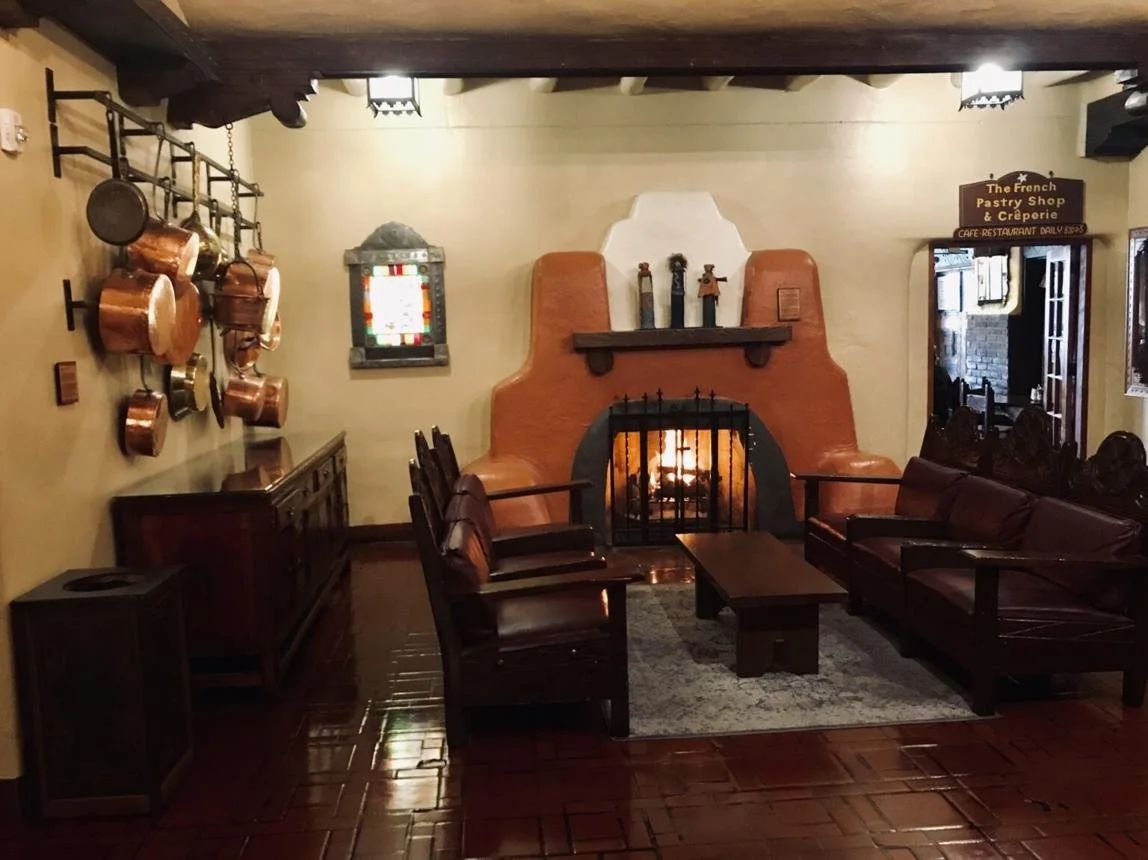
Tucked just off the bustle inside La Fonda on the Plaza is a room that rewards a second look—and a slower pace. Today, unmistakably, it’s the French Pastry Shop—espresso humming, croissants flaking—but the space itself began life in 1949 as La Cantinita, one of the last interiors designed by Mary Colter.
By then, Colter’s long association with the Atchison, Topeka and Santa Fe Railway had already reshaped how travelers imagined the Southwest. Bringing her back—just a few years before her final retirement—was less a practical decision than a kind of artistic encore.
And what an encore it is.
Even as a pastry shop, the room resists its French label. Colter conceived it as an evocation of an old Mexican kitchen—humble, storied, and alive with memory. The chandeliers, with their candle-like bulbs, hover in that familiar Colter space between sacred and domestic. The fireplace anchors the room, but look closely: its bricks, along with those in the small, simulated corner ovens, were salvaged from the old New Mexico Capitol—history quite literally built into the walls.
Then there are the copper pots.
Resting on the mantel, they’re not decorative reproductions but working artifacts, gathered from former Harvey Houses along the railway line. In Colter’s hands, these objects become more than antiques—they’re connective tissue, linking Santa Fe to a wider network of kitchens and shared experience across the Southwest.
This is what Colter did so brilliantly. She didn’t design rooms; she composed atmospheres. Every surface suggests age, use, and continuity, even though the whole was created at once. It’s immersive without being theatrical, precise without feeling staged.
So yes—order the espresso. Enjoy the pastry. But know that you’re sitting inside something far rarer: Mary Colter’s final, quietly masterful room, still doing exactly what she intended—telling a story you can step into.