Seeing What’s Already There: Freeman Tilden and the Art of Interpretation
If you spend enough time in Santa Fe—walking its streets, listening to its stories—you start to notice something: the best moments aren’t when someone gives you more information. They’re when something clicks. A wall, a doorway, a plaza suddenly means more than it did a minute ago.
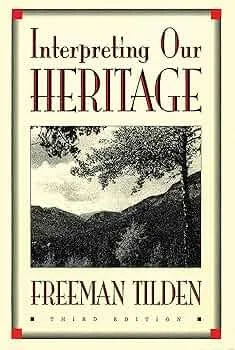
That “click” is exactly what Freeman Tilden was writing about in his 1957 classic Interpreting Our Heritage. And if you lead walking tours—or just love places like Santa Fe—it’s one of the most useful little books you’ll ever encounter.
I was recently reminded of it thanks to filmmaker John Grabowski, whose short documentaries like Sky Island and Ribbon of Sand do something very Tilden-esque: they don’t just show you landscapes—they help you see them.
It’s Not About Information
Tilden’s first—and most important—insight is deceptively simple:
Interpretation is not the same as information.
You can tell someone that the Palace of the Governors dates to the early 17th century. That’s information.
But if you help them feel what it meant for power to be asserted, challenged, and reshaped in that space—that’s interpretation.
Facts are necessary. But on their own, they rarely stick.
Start With the Visitor
Tilden insists that interpretation must connect to something the visitor already knows or feels.
If you begin with dates and names, people listen politely.
If you begin with:
“Imagine arriving here with no idea why you’ve been summoned…”
—they lean in.
The goal is not to simplify history—it’s to relate it.
Interpretation Is an Art
This is where many people get it wrong. Interpretation isn’t just about accuracy or expertise. Tilden calls it an art.
That means:
pacing matters
contrast matters
silence matters
A well-timed pause in front of an ordinary doorway can be more powerful than five minutes of explanation.
Provoke, Don’t Lecture
Tilden’s most quoted line is worth remembering:
“The chief aim of interpretation is not instruction, but provocation.”
In other words, your job isn’t to answer every question—it’s to spark curiosity.
Instead of explaining everything about the Loretto Chapel, you might say:
“Is this a story about craftsmanship… or something else?”
Now the visitor is participating.
Show the Whole, Not the Pieces
A list of facts feels scattered. A story with a through-line feels complete.
In Santa Fe, that through-line might be:
people arriving
a place being reshaped
meanings layered over time
When visitors leave with a sense of the whole, they remember the parts.
Different Audiences, Different Approaches
Tilden also reminds us that not all visitors are the same.
Children, especially, don’t need a simplified adult lecture—they need a different experience altogether.
Even among adults, some want detail, others want atmosphere.
Good interpretation adjusts without losing its core.
Why It Matters
Underneath all of Tilden’s principles is a deeper purpose:
when people understand meaning, they care more.
And when they care more, they’re more likely to preserve what they’ve experienced—whether that’s a landscape, a building, or a cultural tradition.
Seeing Santa Fe Differently
Once you start thinking this way, places like Santa Fe change.
The Plaza isn’t just a square—it’s a stage.
The architecture isn’t just style—it’s a decision.
A quiet doorway isn’t just a doorway—it might be the threshold to something world-changing.
And the role of a guide—or a filmmaker, or a storyteller—is not to add something new.
It’s to help people see what’s already there.
If Tilden is right—and I think he is—then the best tours, like the best films, don’t leave you with more information.
They leave you looking at the same place… and seeing it differently.