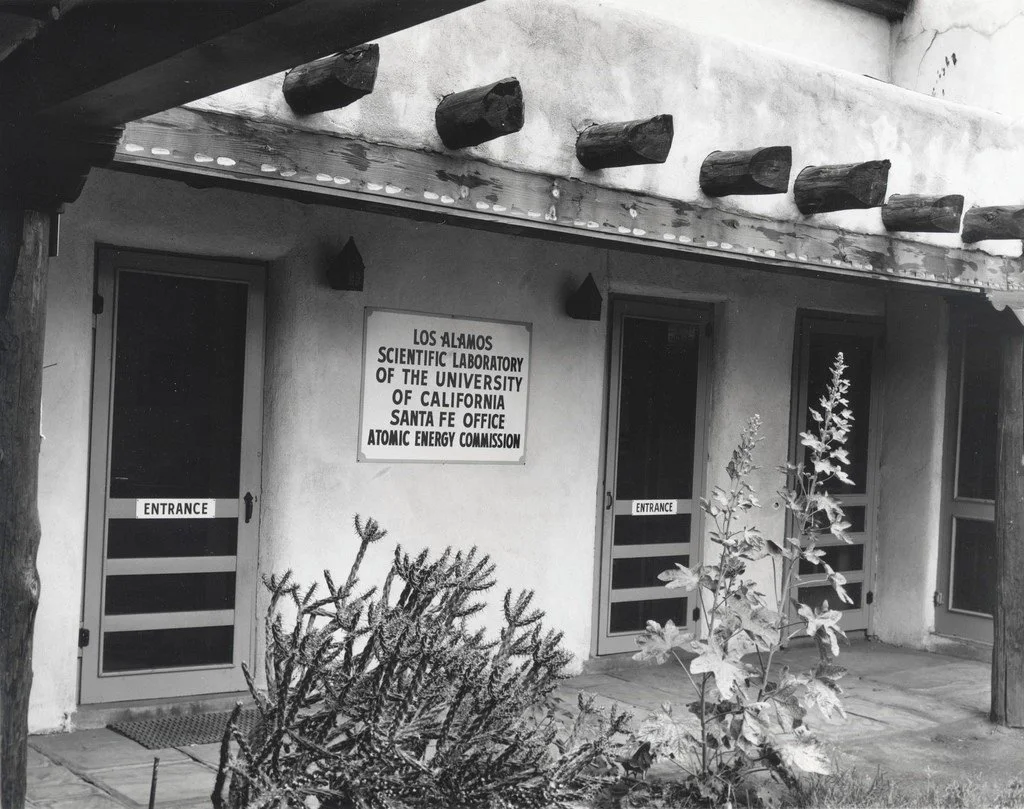
At 109 East Palace, a doorway into the Manhattan Project reveals a story that began decades earlier, in the mountains of northern New Mexico.
Today, 109 East Palace is an unassuming entrance to a courtyard just steps from the Santa Fe Plaza. During World War II, however, it was the gateway to one of the most secretive scientific projects in history. Here, Dorothy McKibbin welcomed the scientists, technicians, and families bound for Los Alamos, where J. Robert Oppenheimer directed the effort to develop the first atomic bomb.
But how did Oppenheimer come to know New Mexico well enough to help select Los Alamos for this extraordinary undertaking? The answer begins twenty years earlier, far from laboratories and military installations, at a guest ranch near the little village of Cowles.
A young man discovers New Mexico
In 1922, Robert Oppenheimer was eighteen years old. After becoming seriously ill while traveling in Europe, he had been sent west by his father to regain his strength through outdoor life. He arrived in New Mexico and found a landscape that would shape the rest of his life.
At Los Pinos Ranch near Cowles, he encountered the mountains, forests, and open country of northern New Mexico on horseback. The ranch, associated with the Chaves family, introduced him to a world quite different from his upbringing in New York. Among the people he met was Katherine Chaves Page, who became a lifelong friend.
Oppenheimer explored extensively on horseback, riding through the Sangre de Cristo and Jemez mountain country. According to the traditional account, one of these early excursions took him to the alpine lake beneath Santa Fe Baldy that became known as Lake Katherine, named for his friend. The lake also held significance for the people of Nambé Pueblo, whose relationship with this mountain landscape long predated its appearance on Anglo-American maps.
The young visitor had no way of knowing that his familiarity with these mountains would one day prove useful to the United States government.
A retreat for a community of physicists
Oppenheimer's connection with New Mexico did not end with that first summer. In the late 1920s, he and his younger brother Frank acquired a rustic property in the Pecos country, which Robert called Perro Caliente—Spanish for “hot dog.”
The ranch became a retreat from academic life and, eventually, a gathering place for Oppenheimer's scientific friends. Physicists visited to ride, camp, enjoy the mountain scenery, and talk about their work. Long before Los Alamos became a secret scientific city, Oppenheimer was already bringing members of the scientific community to New Mexico.
His relationship with the region was therefore much more than a passing affection for its scenery. Over the years, he became familiar with its roads, trails, mountain valleys, and isolated plateaus. He had experienced the landscape on foot and horseback, not simply from a passing train or automobile.
From the mountains to the Manhattan Project
By 1942, the United States was racing to develop an atomic weapon before Nazi Germany could do so. General Leslie Groves, placed in charge of the Manhattan Project, needed a secure location for a new laboratory where scientists could work together on the design of the bomb.
Oppenheimer, by then a prominent theoretical physicist, advocated bringing the scientific effort together at a single, isolated laboratory. When he was appointed scientific director, he also brought something unusual to the assignment: a deep familiarity with northern New Mexico.
The Army investigated several possible locations. One candidate was Jemez Springs, where the proposed site lay in a narrow canyon. During a reconnaissance in November 1942, Groves and his party inspected the area and found it unsuitable. The canyon offered insufficient room for the laboratory's anticipated expansion.
Oppenheimer knew of another possibility.
On a high plateau above the surrounding canyons stood the Los Alamos Ranch School, a secluded boarding school for boys. Oppenheimer had ridden through this country years earlier. He knew the school existed, although he had never attended it.
The mesa offered isolation, room to build, and existing facilities that could be adapted for the new laboratory. Groves inspected the property and approved it. The Army moved quickly to acquire the land, and Los Alamos became the center of the Manhattan Project's bomb-design effort.
The familiar story that Oppenheimer simply stumbled upon the school while riding is incomplete. His earlier travels explain how he knew the place existed; the military's search and the practical shortcomings of alternative sites explain why it was selected.
Back to 109 East Palace
By March 1943, the secret laboratory was taking shape in the mountains. In Santa Fe, Oppenheimer established a small administrative office at 109 East Palace and hired Dorothy McKibbin to manage its daily operations. New arrivals came through her office for instructions, identification, and transportation to Los Alamos. She became known as the gatekeeper to the secret city.
The modest courtyard linked Santa Fe to a remote mesa where scientists were undertaking work that would change the world. Yet the story behind that connection reached further back than the war, to a young man recovering his health, a guest ranch near Cowles, horseback journeys through the mountains, and a lifelong attachment to New Mexico.
Oppenheimer did not choose Los Alamos simply because it was beautiful or because he had once ridden there. His knowledge of the landscape helped him recognize a practical alternative when the Army's first choice proved inadequate. The final decision depended on military requirements, available land, security, and the needs of the laboratory.
Still, the earlier story matters. It reminds us that history sometimes turns on connections formed long before anyone can foresee their consequences.
At 109 East Palace, the Manhattan Project seems to begin behind an ordinary doorway. Its roots, however, extend into the mountains beyond Santa Fe—and into the life of a young physicist who had come west simply to get well.