Santa Fe's Love-Hate Relationship with the Siberian Elm
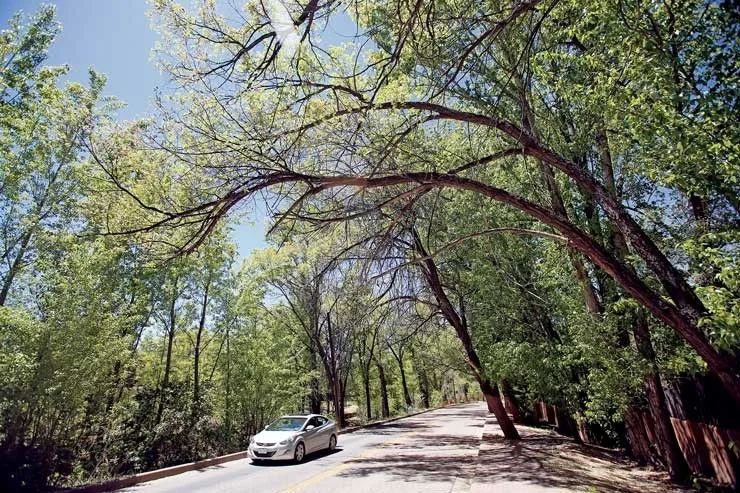
Every spring, Santa Fe experiences a curious phenomenon. Thousands upon thousands of pale green, papery seeds swirl through the air, collecting along curbs, patios, and sidewalks. Within weeks, tiny elm seedlings begin appearing everywhere—in flower beds, cracks in the pavement, and even roof gutters.
Welcome to life with the Siberian elm.
Today, many homeowners regard it as a nuisance, but when the tree first arrived in New Mexico, it was hailed as something close to a miracle. Santa Fe's high desert climate is a difficult place to grow trees. The summers are hot and dry, the winters can be severe, and the soils are often alkaline.
The naturalist Donald Culross Peattie recalled working for the U.S. Department of Agriculture's Office of Foreign Seed and Plant Introduction when a letter arrived from a ranch woman in eastern Montana. "We got no trees hear," she wrote. "They all blowed down or dide. For God's sake send us shade."
Peattie sent her the Siberian elm, newly introduced from Mongolia by plant explorer Frank Meyer. It could survive drought, wind, heat, bitter cold, poor soil—even neglect. Before long, it was being planted throughout the West, including Santa Fe, where fast-growing shade was desperately needed.
The tree succeeded beyond anyone's expectations.
Today, mature Siberian elms cool our neighborhoods and shelter countless birds. At the same time, they scatter astonishing numbers of wind-borne seeds, invade vacant lots and arroyos, and produce volunteers that seem determined to grow in every corner of the city.
The Siberian elm is both blessing and curse, admired and resented in equal measure. Yet it also tells an important story about Santa Fe. The people who planted these trees weren't making a mistake. They were solving a very real problem—how to bring shade and comfort to a harsh, treeless landscape.
Every Siberian elm in Santa Fe reminds us that history isn't found only in adobe walls and old churches. Sometimes it's growing right over our heads.