The Clock That Refused to Keep Still
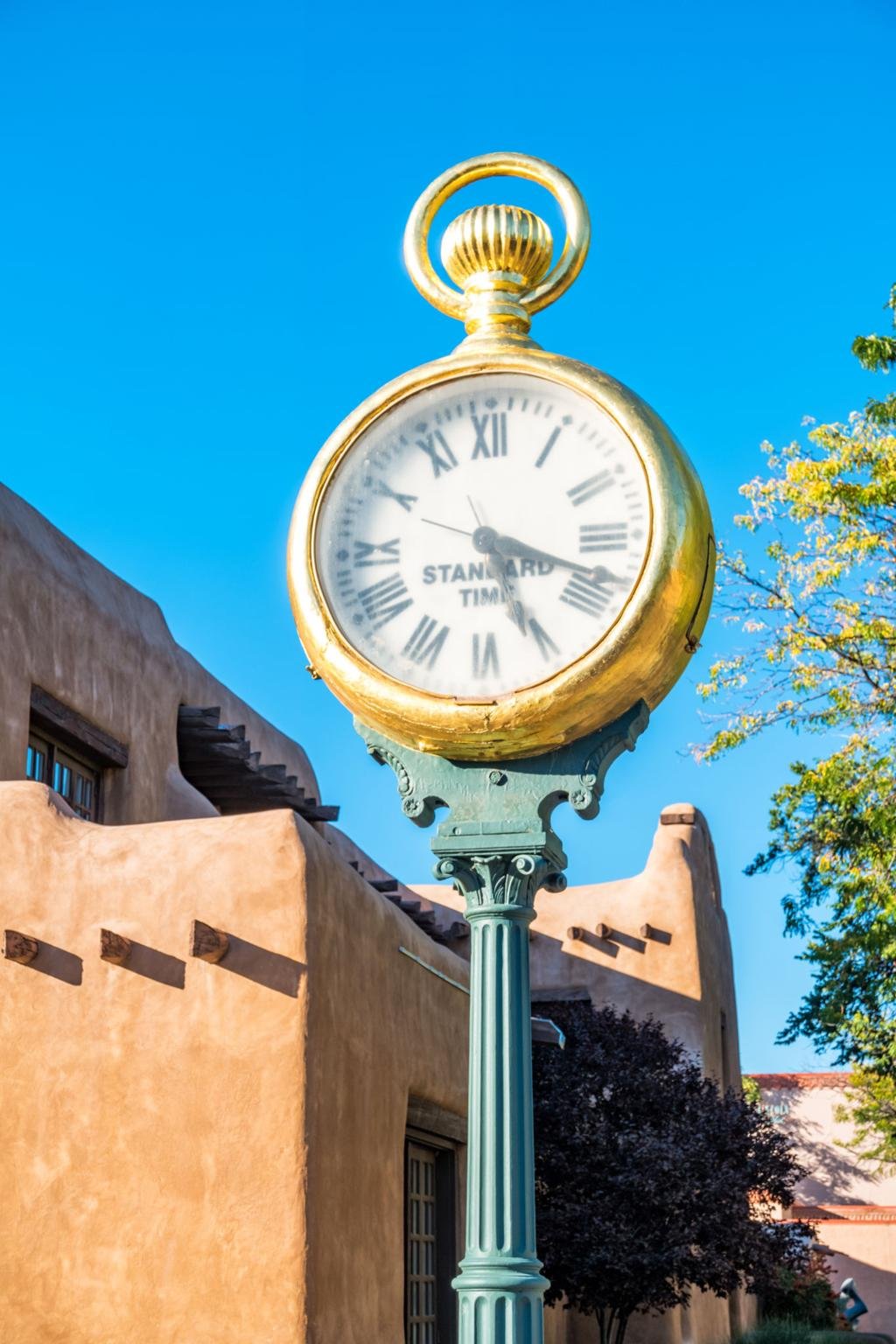
If you’re strolling just off the Plaza near the New Mexico Museum of Art, you might notice what looks like an oversized pocket watch perched on a pedestal. This is the Spitz Clock—one of Santa Fe’s most charming survivors, and, as it turns out, not just one clock but three lives stacked into a single story.
The tale begins in 1881, when the Spitz Jewelry Store installed a giant “clock” out front. There was just one small catch—it didn’t actually work. It was essentially an advertisement, a clever bit of Victorian-era branding meant to catch the eye of passersby.
Around the turn of the century, practicality won out over promotion, and the fake clock was replaced with a real, working one. But Santa Fe was changing, too. In 1915, as one of the city’s first motor trucks rumbled uncertainly around the Plaza, it crashed straight into the clock, knocking it to the ground in dramatic fashion.
Undeterred, jeweler Salamon Spitz acquired yet another replacement—this time a secondhand clock built by the renowned E. Howard & Company. This third version, the one you see today, is something of a mechanical rarity. While most street clocks across America were later converted to electricity, Santa Fe’s Spitz Clock still runs on its original weight-driven gears and must be wound by hand. If you listen closely, you can sometimes hear it quietly working away inside.
After standing outside the jewelry store for decades, the clock was removed in 1967 and spent years in storage before being donated to the city and installed at its current location in the mid-1970s.
Today, a little worn but still dignified, the Spitz Clock is more than a timepiece. It’s a witness—to early advertising, the arrival of the automobile, and Santa Fe’s enduring affection for preserving the past in plain sight.