The Woman with the “Wrong” New Mexico
By the 1930s, Santa Fe was already becoming an artistic myth as much as a place. Promoters, museum directors, railroad companies, and artists all helped shape an image of New Mexico that outsiders would find irresistible: adobe villages glowing in soft light, Native dances, romantic landscapes, and a timeless Southwestern charm.
But then there was Georgia O'Keeffe.
O’Keeffe saw something else entirely.
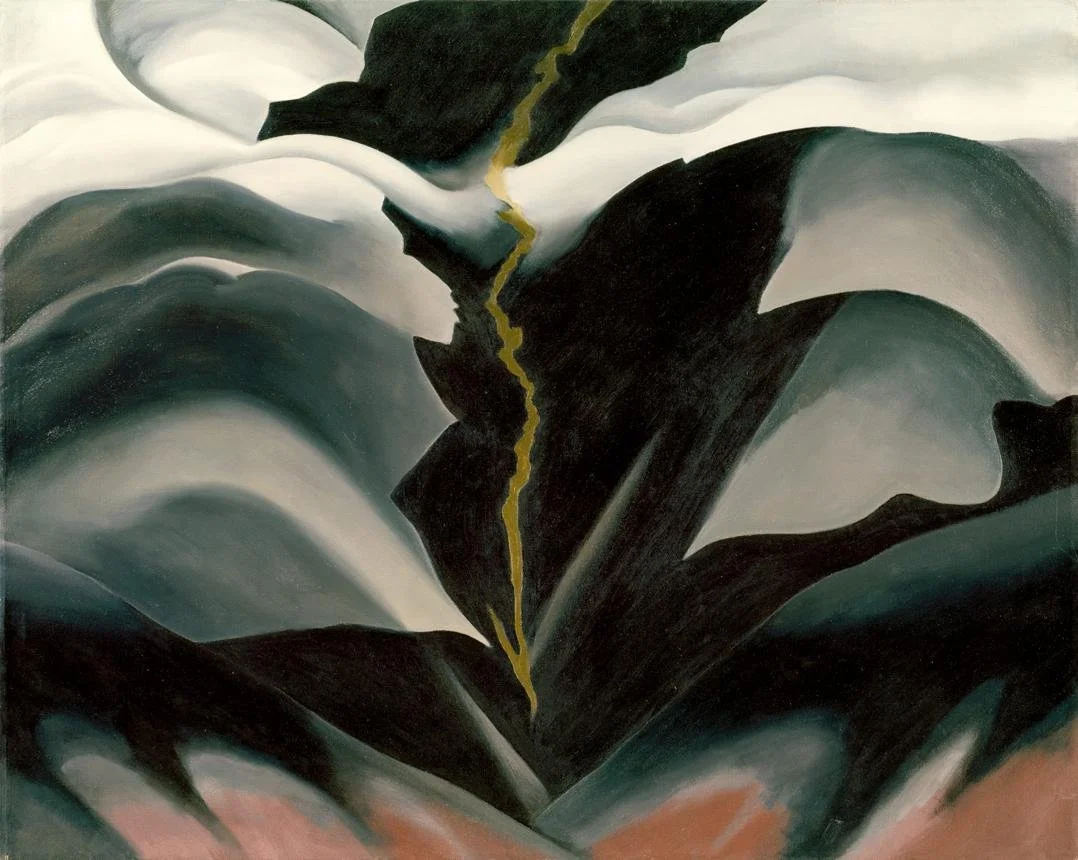
When she arrived in New Mexico, she painted bleached bones, stark hills, black crosses, empty skies, and cliffs stripped almost bare of human presence. Her New Mexico was severe, spacious, even unsettling. It was modernism in the desert — not the picturesque fantasy many Santa Fe cultural leaders hoped to promote.
Among those leaders was Edgar Lee Hewett, the powerful founder of the Museum of New Mexico and a central architect of Santa Fe’s carefully cultivated identity. Hewett helped invent what people now think of as “Santa Fe Style.” Art, architecture, archaeology, and tourism all blended together in his vision of the city.
O’Keeffe did not fit comfortably inside it.
The tension surfaced dramatically in 1936, when discussions arose about a mural commission connected with the Fine Arts Museum. Accounts differ in detail — as Santa Fe stories often do — but the controversy revealed a deep divide over what New Mexico art should be. O’Keeffe’s work was considered too cold, too modern, too private. One museum insider reportedly dismissed O’Keeffe as “a strange sort of freak with big hands,” a remark that now sounds less like criticism than anxiety in the face of an artist impossible to categorize.
And perhaps impossible to control.
The irony, of course, is that O’Keeffe ultimately became one of the defining artistic voices of New Mexico. Today visitors come from around the world seeking precisely the landscapes Hewett’s circle found troubling: the lonely mesas, bone-white forms, and immense silences she painted so fearlessly.
Santa Fe has always balanced two impulses — preserving a myth and confronting a reality. O’Keeffe’s genius was understanding that the desert did not need embellishment. Its emptiness was already enough.