A Brief History of Canyon Road
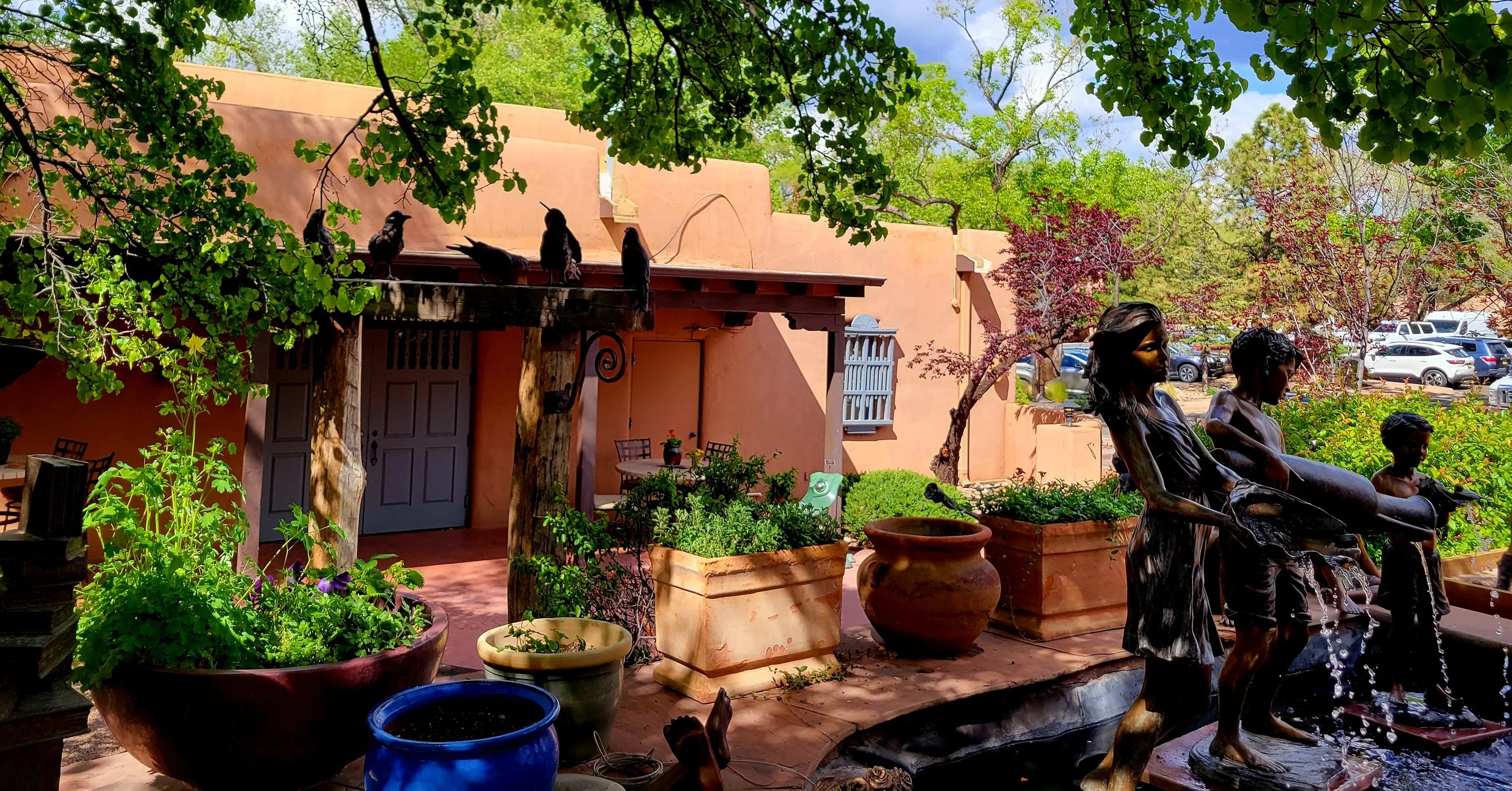
Long before Canyon Road became one of America’s most famous art districts, it was simply a path. Indigenous people used this route for centuries, traveling between the Santa Fe River valley and Pecos Pueblo, following water, fertile soil, and access through the foothills of the Sangre de Cristo Mountains. When the Spanish arrived in the early 1600s, they called it El Camino del Cañón — the road to the canyon.
For generations, Canyon Road was agricultural rather than artistic. Adobe homes, some dating to the 1700s, sat on long narrow plots irrigated by the Acequia Madre. Families raised sheep, corn, wheat, and vegetables in what was then a rural edge of Santa Fe. Even today, hidden behind gallery courtyards and garden walls, traces of that older village landscape remain.
The transformation began quietly in the early twentieth century. Artists arrived in Santa Fe drawn by the extraordinary light, dramatic landscape, and sometimes even the dry climate, believed helpful for respiratory illnesses. Gerald Cassidy became the first artist to permanently settle on Canyon Road in 1915, followed by others connected to the growing Santa Fe art colony — Olive Rush, Randall Davey, Fremont Ellis, and members of Los Cinco Pintores.
At first, these artists did not open formal galleries. They lived and worked in adobe homes, selling paintings directly from their studios. Canyon Road was still a neighborhood: dusty, residential, practical. By the late 1940s it also included grocery stores, bars, workshops, and small trades alongside the artists.
The key turning point came in 1953, when the Artist’s Exchange Gallery opened on Canyon Road — generally recognized as the first formal art gallery on the street, distinct from artists’ private studios. Shortly afterward, sculptor Andrea Bacigalupa established his long-running studio-gallery there as well. Then came a crucial city decision in 1962: Santa Fe designated Canyon Road a “residential arts and crafts zone,” allowing artists and galleries to operate while preserving the neighborhood’s historic character.
From there, the change accelerated. Galleries multiplied through the 1960s and 70s. Old farmhouses became exhibition spaces. Courtyards filled with sculpture. Tourists arrived from around the world.
Today, Canyon Road contains more than one hundred galleries, studios, boutiques, and restaurants packed into a half-mile stretch. Yet what makes it remarkable is not merely commerce. Beneath the paintings and polished courtyards lies something much older: an ancient trail, a farming village, and a neighborhood that somehow became an international art destination without entirely losing its soul.
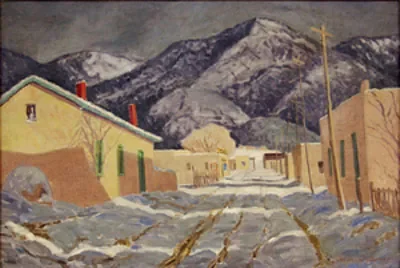
“A Winter Afternoon on Canyon Road” Sheldon Parsons