Arriving in Santa Fe—By Air
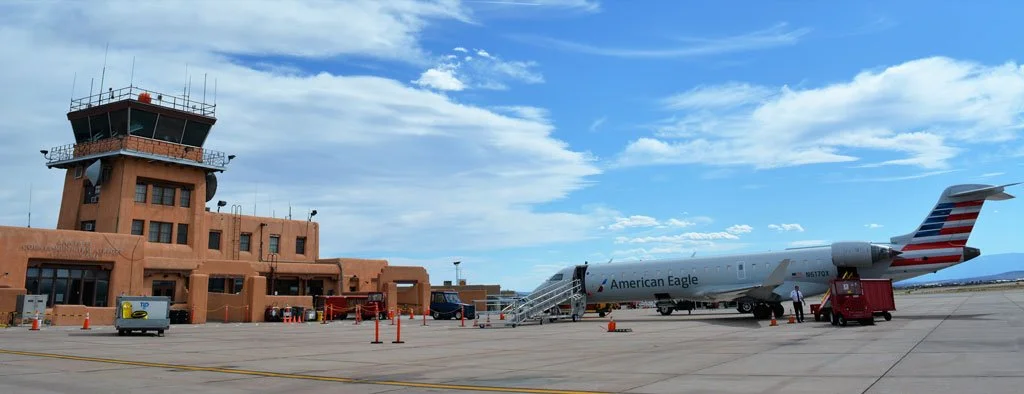
There was a time when arriving in Santa Fe meant stepping off a train at the Lamy or Albuquerque station, perhaps after crossing the country in a Pullman car. If you were lucky, you might even have been met by a Harvey Courier and boarded one of the Fred Harvey Company’s famous Indian Detours touring cars.
Today, more and more visitors arrive by air. And yet, somewhat remarkably, arriving at Santa Fe Regional Airport can still feel like stepping into another era.
The airport is small. There are no sprawling terminals, endless corridors, or automated trains carrying passengers from one concourse to another. Instead, you walk through a modest Southwestern building, look out toward the mountains, collect your luggage, and—almost before you know it—you are on your way into Santa Fe.
There is a reason the terminal has such a distinctive character. The present airport dates back to the years just before World War II, when the federal government began funding airports around the country. A new 1,450-acre site southwest of Santa Fe was selected in 1941, and the airfield was completed in 1942. It was originally intended in part to serve military aviation at Santa Fe’s considerable elevation.
After the war, the airport became a civilian facility. In 1955, Santa Fe and Santa Fe County agreed to develop a new airport, and two years later a new terminal opened.
And here is the very Santa Fe part of the story: the architect was John Gaw Meem.
Meem is probably the single architect most closely associated with the transformation of Santa Fe's architectural identity in the twentieth century. His buildings helped establish what we now think of as Santa Fe's Pueblo-Spanish Revival style. So it seems entirely appropriate that the city's airport terminal—the place where many visitors receive their very first impression of Santa Fe—was designed by Meem.
The terminal was designed in an era when an airport was still a relatively intimate place. Passengers didn't disappear into a giant complex of gates and moving walkways. The building itself was part of the experience. Meem's terminal gave the airport a distinctly regional character, using architectural ideas that visitors would recognize elsewhere in Santa Fe.
For decades, the little terminal served Santa Fe remarkably well. By the 1960s, major airlines were flying larger aircraft into the city, including early jet service. Then, in 1972, commercial service by Frontier and Texas International abruptly ended after deteriorating runway pavement caused problems for aircraft. For a while, Santa Fe returned to being served largely by smaller commuter aircraft.
The airport has changed considerably since then. The terminal has been renovated, security requirements have changed, passenger numbers have grown, and today's visitors may arrive on modern regional jets rather than the aircraft of Meem's era.
But the little building endured.
Recent expansion has added considerably more space and modern facilities while deliberately retaining what airport officials have called the building's “quaintness.” The first phase of the expansion was completed in the 2020s, bringing the airport into the twenty-first century without entirely sacrificing the character of its mid-century predecessor.
And that makes the airport an unexpectedly appropriate introduction to Santa Fe.
The journey may begin with a modern airliner, but once you walk through the terminal doors, the experience changes. The architecture, the scale, the light, and—on a clear day—the Sangre de Cristo Mountains outside all announce that you have arrived somewhere very different.
In Santa Fe, even the airport has a history.
So welcome to Santa Fe.
Your airplane may be modern. Your arrival doesn't have to be.