The Felipe Delgado House: A House That Tells Santa Fe's Story
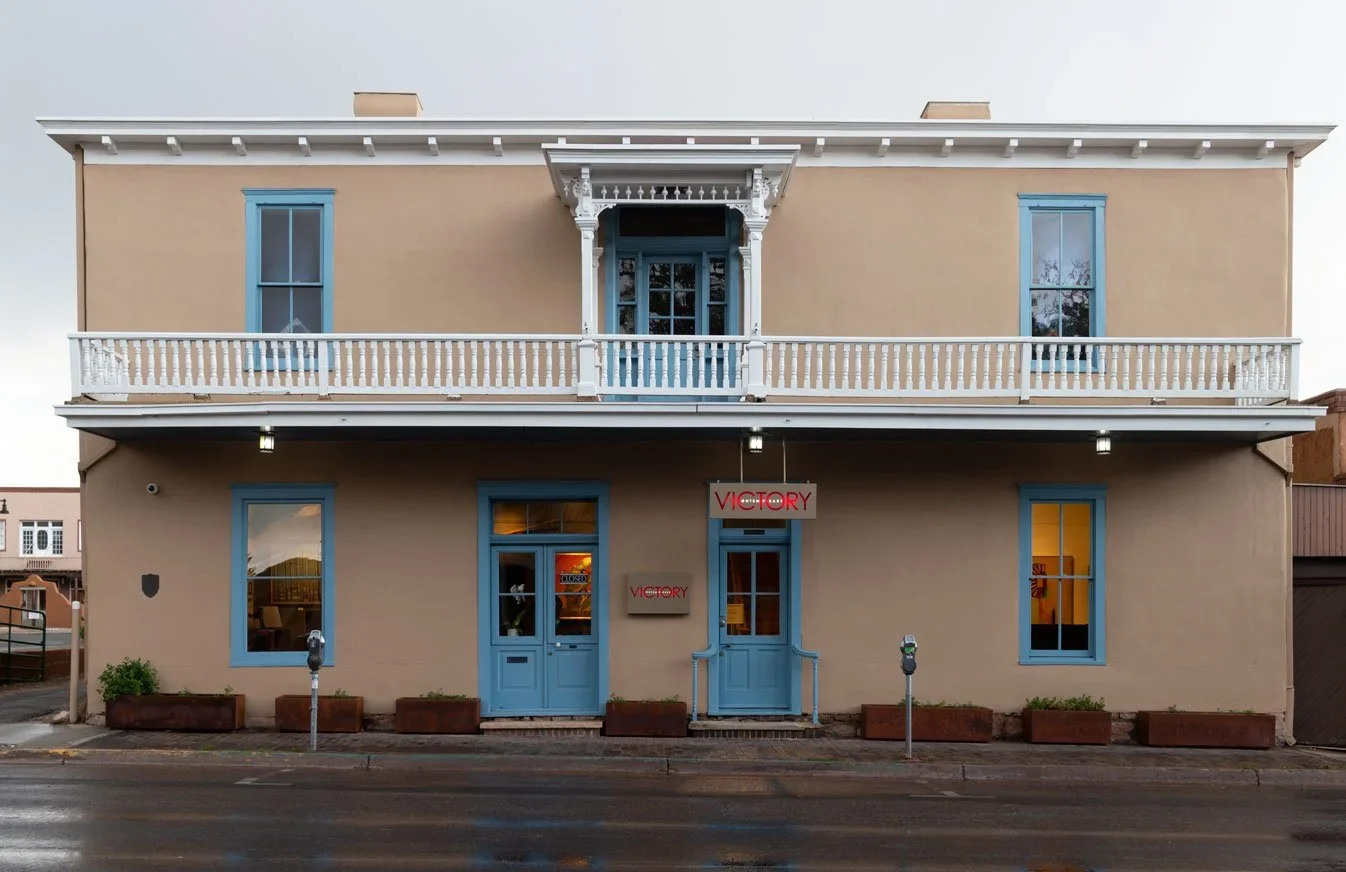
Just a block from the Santa Fe Plaza, on West Palace Avenue, stands a house that tells an unusually complete story about Santa Fe architecture.
The Felipe B. Delgado House looks, at first glance, like the sort of old adobe building visitors expect to find in Santa Fe. But look a little closer and something more interesting emerges. Its thick adobe walls are combined with a pitched metal roof, carefully finished wood trim and a remarkable second-story balcony. This is not Pueblo architecture, nor is it quite the architecture of the East. It is Territorial—a distinctly New Mexican mixture of local building traditions and American influences.
Felipe B. Delgado, a prominent Santa Fe merchant, built the house around 1890 on the site of his mule-trading business. His family had been involved in the commerce of the Santa Fe Trail, and the house reflects a period when Santa Fe was changing rapidly. The arrival of American rule, new commercial connections and, soon, the railroad brought new materials and architectural ideas to the old town.
The house itself may have evolved along with those changes. Historic research suggests that two earlier one-story buildings may have been joined before the second story was added. By the 1890s, the distinctive balcony was taking shape, creating the elegant façade we see today.
That balcony is perhaps the house's most memorable feature. Supported by slender wooden columns and sheltering the front of the second floor, it is both practical and decorative—a reminder that nineteenth-century Santa Fe architecture was not simply about thick adobe walls. It was also about incorporating new materials, new tastes and new ways of presenting a house to the street.
Then, nearly eighty years later, the Delgado House acquired another chapter in its history.
By the late 1960s the building had deteriorated and was threatened with demolition. Architect John Gaw Meem, one of the central figures in Santa Fe's twentieth-century architectural transformation, purchased it and undertook its restoration. Meem was hardly an impartial observer: he had spent decades studying and reinterpreting the regional architecture that would become the basis of Santa Fe's Pueblo and Territorial Revival styles.
Yet here he was working not on a new interpretation, but on an actual nineteenth-century building.
Meem's restoration is part of a larger story that is essential to understanding modern Santa Fe. During the twentieth century, architects, preservationists and civic leaders increasingly decided that Santa Fe's historic appearance was something worth protecting. Meem was one of the most influential figures in that movement. The Delgado House provides an unusually concrete example of that philosophy: rather than replacing an old building with something new, he rescued and restored an authentic piece of Santa Fe's architectural past.
And there is an intriguing detail for anyone interested in the way Santa Fe's historic buildings acquired their colors.
During the restoration, the exterior was stripped back to earlier surfaces. According to an account published at the time, enough of the original color scheme remained on the woodwork to allow Meem to reproduce it. In other words, at least in this case, the colors were not simply chosen because someone thought they looked “Santa Fe.” There was physical evidence beneath the later layers of paint.
That raises a larger question.
When we see a blue door, a painted window frame or brightly colored woodwork on an old Santa Fe building, how old is that tradition? Is it Spanish? Mexican? Territorial? Pueblo? Victorian? Or are some of the colors we now think of as quintessentially Santa Fe actually products of the twentieth-century reinvention of the city?
The Delgado House doesn't answer all those questions. But it reminds us that Santa Fe's architecture is more complicated—and more interesting—than the familiar image of an adobe building painted in earth tones.
Today the house remains a remarkably well-preserved piece of that story. If you're walking west from the Plaza, look for the balcony, the adobe walls and the carefully proportioned woodwork. And, if the current occupant is open, step inside.
That's one of the pleasures of Santa Fe architecture: sometimes the history isn't behind a museum rope. Sometimes you can simply walk through the door.