Bishop's Lodge: A Retreat in the Tesuque Valley
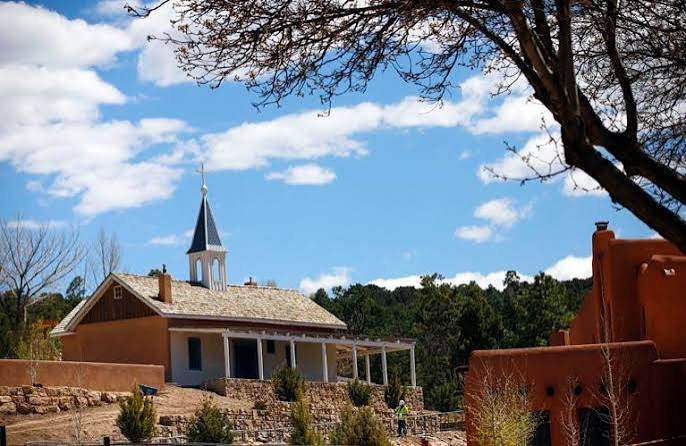
Long before Bishop's Lodge became one of Santa Fe's most celebrated resorts, the sheltered valley beneath the Sangre de Cristo Mountains attracted people for a simpler reason: water.
Like many Spanish colonists who settled north of Santa Fe during the eighteenth century, Archbishop Jean-Baptiste Lamy was drawn to one of the cool, well-watered pockets where streams descended from the mountains. Here, fruit trees, gardens, and livestock could flourish in a landscape that otherwise demanded careful attention to water. Lamy, the first Archbishop of Santa Fe and the church leader immortalized in Willa Cather's Death Comes for the Archbishop, acquired land in the Tesuque Valley in the 1850s and established a rural retreat he called Villa Pintoresca—the "Picturesque Villa."
The small adobe chapel he built in 1874 still stands today, a tangible link to territorial New Mexico and one of the oldest surviving structures on the property. From this quiet refuge, Lamy could look westward across the valley toward the Rio Grande Valley while remaining surrounded by the cottonwoods, orchards, and mountain scenery that first attracted settlers to the area.
After Lamy's death, the property entered a new chapter that mirrored Santa Fe's own transformation. Around 1915, members of the Pulitzer family acquired the estate as a western residence, part of a growing interest among affluent easterners who were discovering Santa Fe's distinctive landscapes and architecture. A few years later, Denver mining entrepreneur James Thorpe purchased the property and developed Bishop's Lodge Ranch, helping establish the guest-ranch tradition that flourished throughout northern New Mexico during the 1920s and 1930s.
That era gave rise to Indian Detours, dude ranches, and retreats such as Ghost Ranch, inviting visitors to experience a romantic vision of the Southwest. Bishop's Lodge became part of that movement while remaining rooted in a much older story—one that began with a mountain stream, fertile soil, and a bishop who recognized the beauty of a hidden valley.