How the Land Changes People
The first Spanish colonists who entered northern New Mexico in the late sixteenth and early seventeenth centuries arrived as representatives of an empire. They carried with them the assumptions of imperial Spain: land to be claimed, souls to be converted, settlements to be established under crown and church.
But history has a way of reshaping people as much as people reshape history.
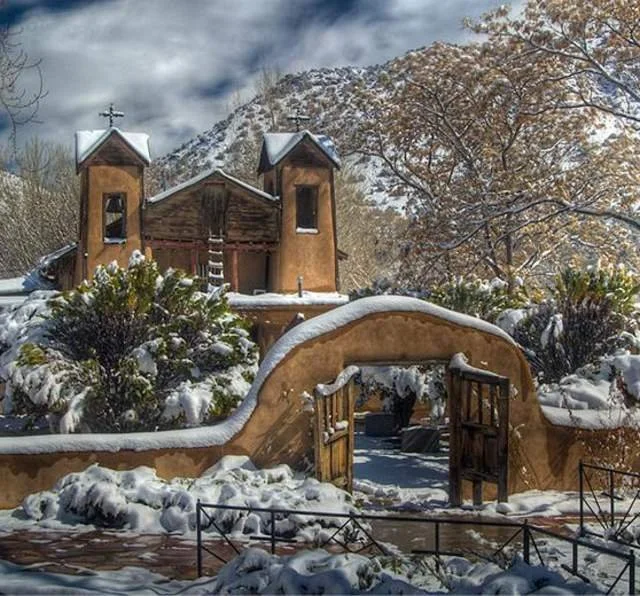
Over generations, the isolated villages of northern New Mexico — places tucked into mountain valleys along what we now call the High Road to Taos — slowly produced a culture unlike anywhere else in North America. Writers like Harvey Fergusson, in Rio Grande, and Erna Fergusson, in Our Southwest, were already describing these villages nostalgically in the 1930s: communities of paisanos whose lives revolved around acequias, saints’ feast days, family orchards, shared labor, and ancestral ties to the land.
These were no longer the wealthy agents of empire. Most were small farmers, shepherds, woodcutters, and craftsmen living in remarkable continuity with earlier centuries. Families often remained in the same valley for generations. Churches and moradas stood at the center of village life. The mountains themselves became part of identity.
Something profound had happened over time. The descendants of colonists had themselves become deeply rooted people.
Their worldview did not become identical to that of the Pueblo communities around them, whose relationship to place reached back much farther. Yet the land had softened and transformed the original colonial mentality. Attachment gradually replaced ambition. Belonging began to matter more than conquest.
Modern visitors sometimes struggle to understand this older New Mexico because it contrasts so sharply with contemporary American mobility. Today many people can live almost anywhere. But in the old villages, identity was inseparable from place, memory, and continuity.
Perhaps that is one of the enduring truths of New Mexico itself. People may arrive here pursuing opportunity, reinvention, or escape. But those who remain long enough are often changed by the landscape — by its scale, its silence, its history, and its demands.
Almost everyone who stays here long enough is changed by the land.