The Pass Where New Mexico’s History Converges
There are places in New Mexico that feel less like destinations than crossroads of time itself. One of those places is Pecos National Historical Park.
Just east of Santa Fe, where the southern edge of the Sangre de Cristo Mountains narrows into a natural corridor, lies a passageway that has shaped the history of the Southwest for centuries. Nearly everyone who ever traveled through northern New Mexico eventually came through here. Ancient Puebloan footpaths crossed this gap between the Great Plains and the Rio Grande Valley long before Europeans arrived. Later came Spanish entradas, fur trappers, traders on the Old Santa Fe Trail, soldiers, railroad surveyors, tourists on Route 66, and eventually the steady stream of cars rushing along Interstate 25.
All the trails seem to gather at Pecos.
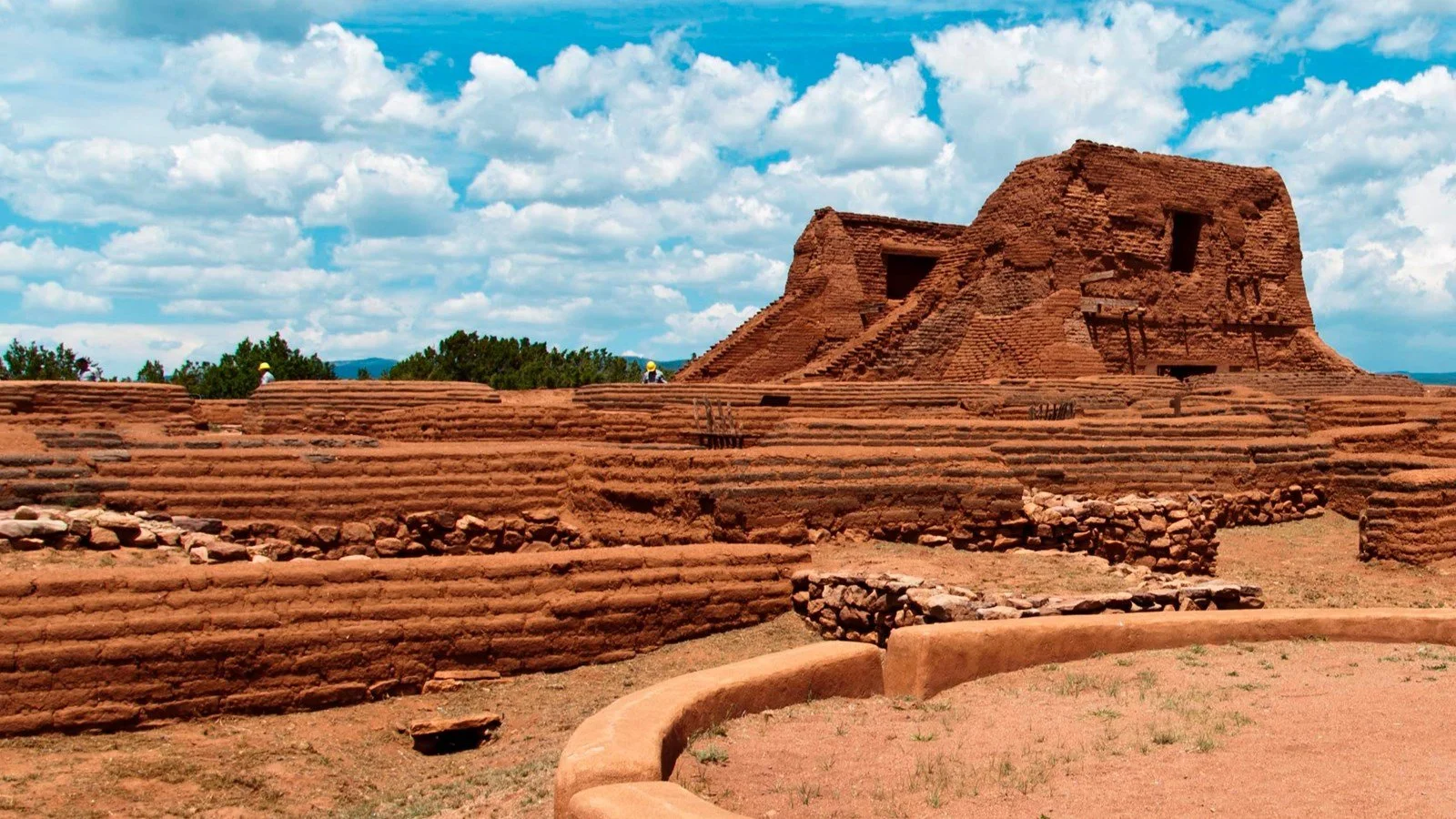
At the heart of the park are the haunting remains of Pecos Pueblo, once one of the largest and most influential Pueblo communities in the Southwest. From this strategic location, the Pecos people stood at the meeting point of worlds: Pueblo and Plains cultures, trade and ceremony, alliance and conflict. The immense ruins still suggest the scale and importance of the settlement.
Rising above the ancient pueblo walls are the crumbling remains of Spanish mission churches, reminders of the dramatic and often painful encounter between Native and European civilizations. Few places in New Mexico compress so much layered history into a single landscape.
The park also preserves part of the battlefield of the Battle of Glorieta Pass, the pivotal Civil War clash sometimes called the “Gettysburg of the West.” It was here, in these mountain passes, that Confederate ambitions in the Southwest were halted, changing the future of the territory.
And yet Pecos is not merely historical. It is beautiful in the way northern New Mexico can be beautiful almost beyond explanation. To the north rise the forested Sangre de Cristos; to the south glows the long sandstone wall of Glorieta Mesa. Winds move through the grasses. Ravens drift overhead. Light changes by the hour.
The park’s museum is intimate and thoughtfully done, and the ranger-guided walks are among the best interpretive programs in the region — less performances than conversations with the landscape itself.
To visit Pecos is to encounter New Mexico in concentrated form: Indigenous history, Spanish colonization, frontier trade, railroads, war, migration, faith, endurance, and geography all bound tightly together in one narrow pass through the mountains.
Some places are scenic. Some are historic.
Pecos is both — and something more besides.