The Hidden Courtyard on Palace Avenue
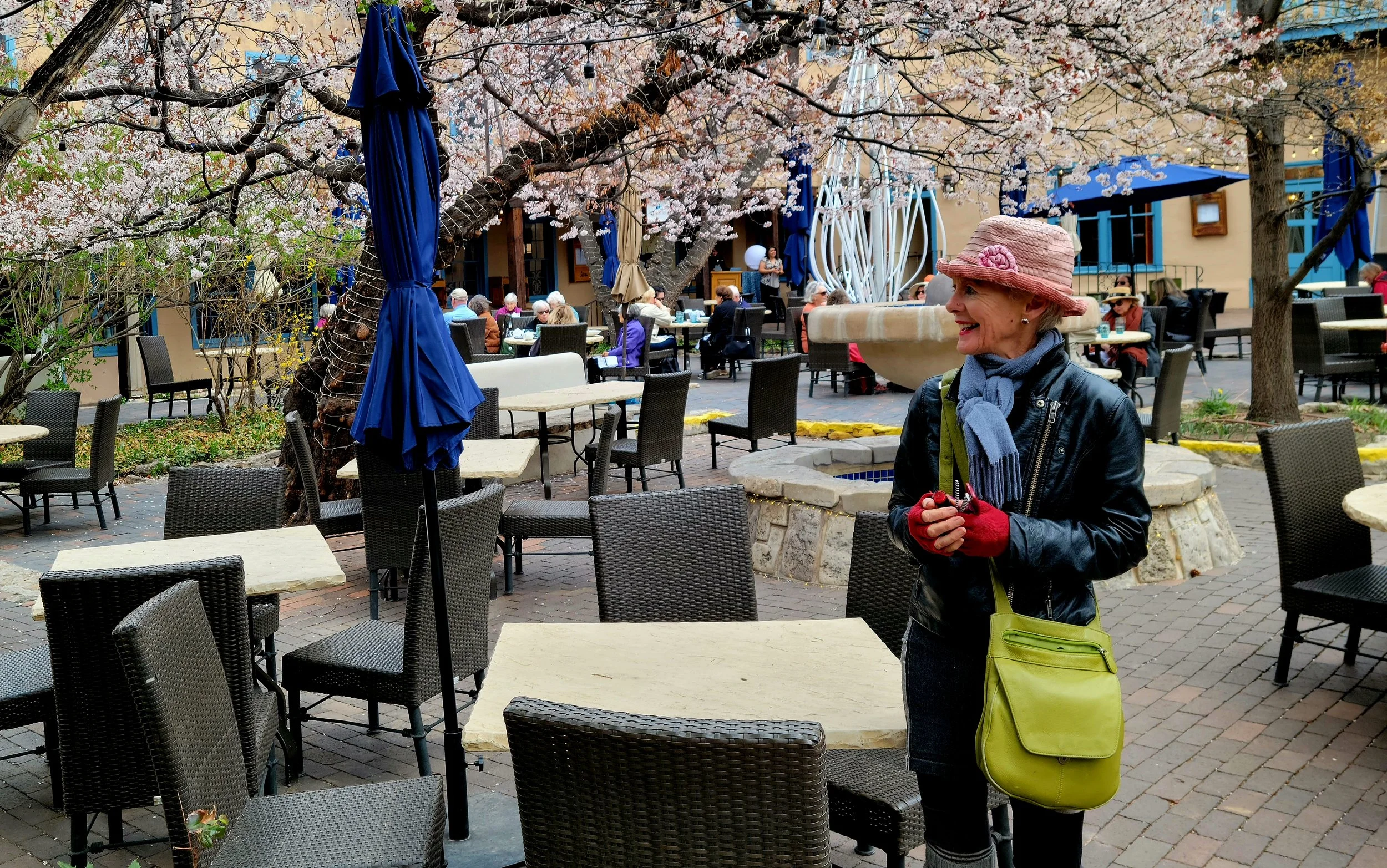
Most visitors walking along East Palace Avenue in Santa Fe have no idea what lies behind the long adobe facade and shaded portal. Then someone steps through the passageway into Sena Plaza — and almost invariably stops for a moment in surprise.
Suddenly the street noise fades. There are gardens, fountains, brick paths, deep portals, blue-painted trim, balconies, and quiet courtyards unfolding one after another beneath cottonwoods. It feels less like entering a shopping arcade than discovering a hidden world.
And in a sense, that is exactly what it is.
The origins of the property reach back to the years after Don Diego de Vargas’s reconquest of New Mexico in the 1690s, when land east of the Palace of the Governors was granted to Captain Arias de Quiros. Over generations, that tract passed through some of Santa Fe’s old Hispano families, especially the Sena family, who expanded the compound into a substantial hacienda during the nineteenth century.
What visitors experience today still preserves something essential about the old Spanish Colonial building tradition. Unlike Anglo-American houses that present themselves outwardly to the street, the classic New Mexican hacienda turned inward around placitas and courtyards. Thick adobe walls offered privacy and protection, while daily life centered around sheltered gardens, portals, wells, and work spaces within the compound itself. Sena Plaza remains one of the best surviving places in Santa Fe to feel that inward-looking architectural rhythm.
But the story does not end there.
In the 1920s, Santa Fe was reinventing itself. Artists, architects, and preservationists began restoring old adobe compounds and reshaping them into what became known as the “Santa Fe Style.” Sena Plaza was remodeled during this period under the guidance of artist and designer William Penhallow Henderson, whose work helped define the romantic Pueblo-Spanish Revival aesthetic now associated with the city.
That is where many of the graceful Territorial details appear: the wooden trim painted in soft blue, the brick coping, the carved brackets, and especially the triangular pediments above doors and windows — echoes of Greek Revival design filtered through frontier New Mexico. Territorial Style architecture itself was a fusion: adobe construction meeting American tastes after the arrival of the United States in 1846.
Even the blue-painted woodwork carries old meanings. Throughout New Mexico, blue window frames and puertas were often believed to repel evil spirits or insects, while also reflecting the precious color of sky and water in an arid land. Whether practical, symbolic, or simply beautiful, the tradition endures.
Perhaps that is why Sena Plaza leaves such an impression. It is not frozen in a single era. Spanish Colonial foundations, Territorial ambitions, and twentieth-century artistic reinvention all coexist there peacefully in the shade. Like Santa Fe itself, the plaza became most fully itself by layering histories rather than erasing them.