When Santa Fe Tried to Look Like Everywhere Else
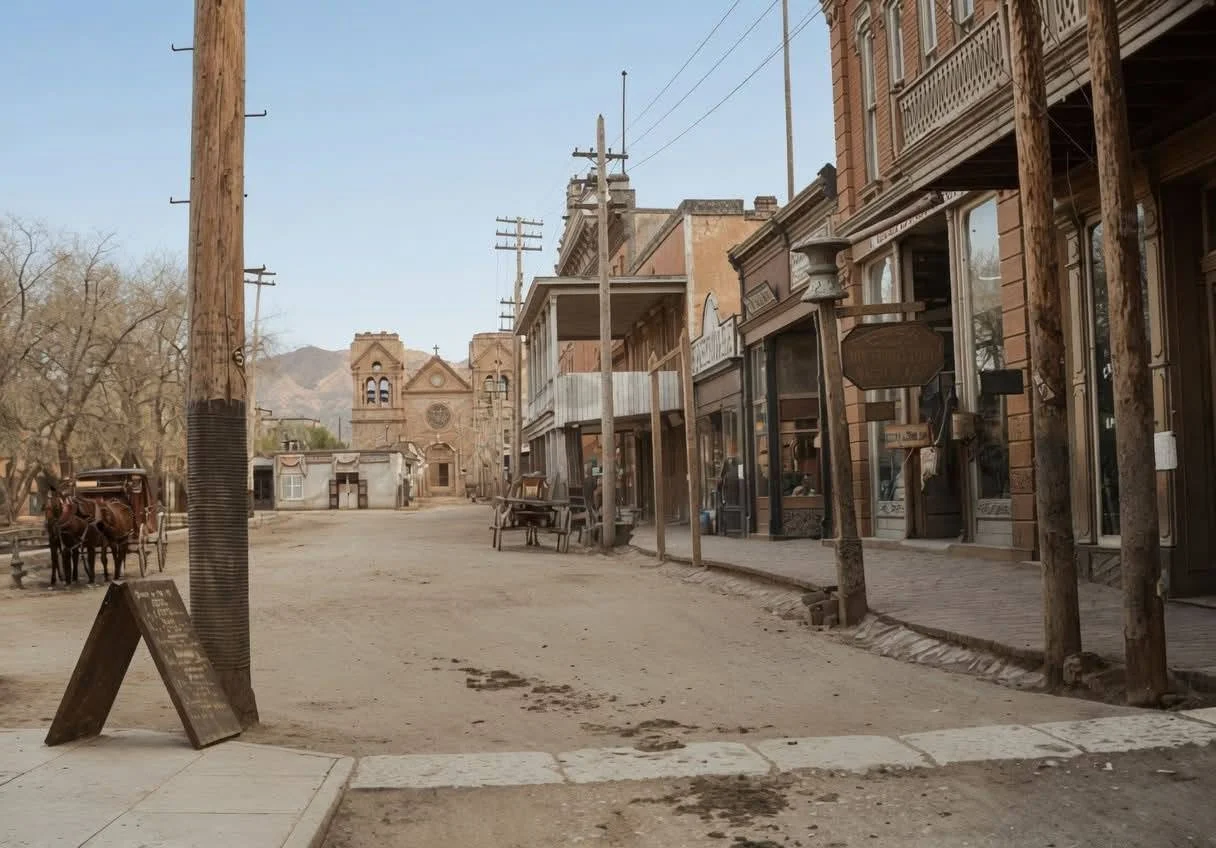
Visitors often tell me that walking through downtown Santa Fe feels like stepping back in time. Adobe walls, vigas, narrow streets, and the Palace of the Governors create the impression that the city has looked this way for centuries.
But it wasn't always so.
The remarkable photograph above, looking west along San Francisco Street toward the Cathedral Basilica, captures a Santa Fe that would surprise many people. Wooden storefronts with false fronts line the street. Two-story Victorian commercial buildings stand shoulder to shoulder with balconies and decorative trim. Utility poles and a web of electric wires dominate the skyline. Horse-drawn wagons still share the unpaved street, yet the architecture reflects the optimism of a rapidly modernizing America.
This was Santa Fe around the turn of the twentieth century.
The arrival of the railroad in nearby Lamy in 1880—and finally into Santa Fe itself a few years later—brought new building materials, new businesses, electricity, improved water systems, telephones, and eventually automobiles. Like countless western towns, Santa Fe eagerly embraced progress. Brick, stone, pressed metal, and ornate Victorian details replaced many of the older adobe structures around the Plaza.
There was another reason for this transformation. New Mexico was seeking statehood, finally achieved in 1912. Many civic leaders wanted to demonstrate that Santa Fe was no longer an isolated Mexican frontier town but a modern American capital. Eastern architectural fashions became symbols of prosperity, progress, and respectability. In some circles, the city's Hispanic and Indigenous architectural traditions were viewed as reminders of a past to be overcome rather than celebrated.
Ironically, it was only a few years later that attitudes changed dramatically.
Artists, archaeologists, preservationists, and civic leaders—including Edgar Lee Hewett and architect John Gaw Meem—began to recognize that Santa Fe possessed something no other American city could claim: a distinctive architectural heritage rooted in Pueblo and Spanish traditions. Rather than copying Denver, Kansas City, or St. Louis, why not embrace the character that made Santa Fe unique?
Beginning in the 1910s and accelerating through the 1920s and 1930s, many of those Victorian facades disappeared. Buildings were remodeled with adobe-like walls, rounded corners, projecting vigas, canales, and earth-toned plaster. The Palace of the Governors became the model rather than the exception.
Today, it's easy to romanticize the preindustrial city and criticize the era of modernization. But that would overlook the genuine improvements those years brought: electric lights, cleaner water, better sanitation, improved transportation, and economic opportunity. Santa Fe needed those advances just as much as any growing American community.
The city we enjoy today is really the product of both eras. Modern infrastructure quietly supports daily life, while thoughtful preservation allows visitors to experience the architectural spirit of a much older Santa Fe.
That combination may be one of the city's greatest achievements: not preserving the past unchanged, but choosing which parts of its history deserved to be remembered.